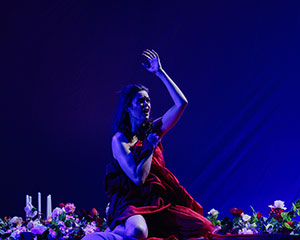
 Left – Valda Wilson. Cover – Valda Wilson, Caitlin Hulcup and Chorus of Christians. Photos – Robert Catto
So you like the Messiah? Theodora is better.
That’s my opinion, and it was shared by the cognoscenti who heard its first performance in 1750, despite its lack of success with the public – and also by its composer. The work was, however, little performed until the revival by Glyndebourne in 1998, directed by Peter Sellars. Of course, being an oratorio, it was not originally intended for the stage, but Lindy Hume, who directs Pinchgut’s production with such insight, saw the Sellars production and was deeply impressed by its stage possibilities.
Theodora’s theme is the suppression of honest, virtuous thought and practice by the egocentric barbarity of tyranny. Its parallel in modern Australia is the vilification of the Greens, especially, but not only, by the tyrannical right wing of politics, egged on by Murdoch’s gutter press. But, distasteful as our political situation is, our political right does stop short of actually murdering its opponents, even if it tears them screaming out of Parliament.
However, the power of the colonising Romans in 4th century Turkey (where the oratorio is set), as formerly of the colonising British, and now of the colonising Americans, was absolute. It was the time of Diocletian, who famously threw Christians to the lions when their religion was then spreading rapidly and whose influence was growing, rather as that of the Greens is today. The governor of Antioch, Valens, who is the tyrant figure here, was sung by Andrew Collis, and his aria Racks, gibbets, swords and fire riveted the audience by its display of rage without boundaries, that fury bordering on madness for which tyrants such as Hitler are known. And his repulsive, public groping of Theodora reminded everyone of the future president of the United States, who many fear will turn out to be a tyrant of sorts.
The two principal parts were both performed with consummate, sometimes breathtaking virtuosity, yet also with hauntingly beautiful soft, lyrical lines when the score suggested so. Valda Wilson’s Theodora was full of inner conviction, and to hear her soar effortlessly, without strain of any kind, flawlessly accurate yet meltingly smooth, to unexpectedly high notes, was one of many intense pleasures of the night. Christopher Lowrey, who sang the role of Didymus, a Roman soldier who converts to Christianity after falling in love with Theodora, matched Valda perfectly, and their two short duets were nothing short of exquisite. And Ed Lyon, the haut-contra-like tenor who sang the equally demanding role of the decent, untyrannical Roman soldier who is detailed to enforce Valens’ edicts, was clear and agile, but also expressive and thoughtful when his music reflected on the dilemma facing those ordered to commit acts against their own consciences. Indeed, I have rarely seen a production where the voices so perfectly suited the dramatic demands of their roles.
Having heard some of the choruses from the Glyndebourne version myself, I was very much looking forward to hearing Pinchgut’s chorus tackle it without the operatic vibrato of Glyndeborne’s chorus, all of whom want to be opera stars, and few of whom are trained in Baroque singing style. Cantillation is always a particular jewel of Pinchgut’s productions, but my high expectations were exceeded last night. Theodora has some of the most bewitching choruses Handel ever wrote – some reminiscent of Messiah, but also many thoughtful, profound slow pieces to be sung by the oppressed Christians, as well as rowdy thoughtless ones sung by the “prosperous” Romans. Cantillation, though perhaps slightly male-voice-heavy, sang with a blend of tender lyrical phrasing and massive energy, always coupled with a clarity of texture few opera choruses anywhere can match. Those who hear this production will go away with the sound of its wonderful choruses, as much as the beauty of Valda Wilson’s soaring soprano, in their ears for days to come.
From the first bars of the overture, the Orchestra of the Antipodes exploded into the action under Erin Helyard’s energetic and deeply informed direction. Handel doesn’t write enough for the wind instruments, in my opinion, especially compared to the likes of Rameau and Charpentier – fancy getting a flautist just to play in one aria, tellingly effective as Michaela Oberg made its four notes – but when Handel does use them in this score, Erin Helyard made sure that no effect was lost. Particularly striking was Brock Imison’s extraordinary baroque contrabassoon, an instrument so long that it practically extended to the first gallery in Angel Place, and so low that the floor seemed to shake ever so slightly at its low notes. And the oboists Amy Power and Jane Downer – wow, to play the baroque oboe so that their sound excites an already exciting string sound, as they did, is something we hear all too rarely.
Pinchgut is such a class act. I have heard almost all their productions, and even at the beginning the orchestra was already remarkable. Now what struck me was the easy yet elated confidence with which they play together as an ensemble, plastic, all going together, in unimpeachable Baroque style, with the slightest hint from their conductor. The direction, under the guidance of Lindy Hume, one of our leading directors, engaged deeply with the very modern issues that Theodora brings to the surface. And there is simply not a weak link on the stage.
I say, go and hear it. You will have a hundred chances to hear Messiah, but far too few to hear this masterpiece.
Pinchgut Opera presents
Theodora
by G F Handel
Director Lindy Hume
Venue: City Recital Hall, Sydney
Dates: 30 November – 6 December 2016
Bookings: 02 8256 2222
Sydney Reviews
Theodora | Pinchgut Opera
- Details
- Nicholas Routley
Most read Sydney reviews
The Lark | Hey Dowling
Noni Hazlehurst brings Rose and The Lark to colourful and compelling life in this one-woman show.
Pride & Prejudice* (*sort of) | Neil Gooding Productions & Woodward Productions
This rollicking musical take on Jane Austen’s beloved novel is a side-splitting crowd pleaser.
Heartbreak Hotel | EBKM
Heartbreak Hotel invites its audience into an intimate portrait of the universal and isolating experience of heartbreak.
Current | Sydney Dance Company
While Bonachela’s work is, as always, dreamily lovely, for me the highlights were absolutely the three commissioned choreographers: Azzam Mohamed, Jenni Large and Raghav Handa.
The Gospel According to Paul – The Second Coming | Soft Tread Productions
The Gospel According to Paul is meticulously crafted entertainment. It’s uplifting without pulling any punches.
More from this author
The First Murder | Pinchgut Opera
In the care of Pinchgut Opera’s director, Erin Helyard, this music, formulaic as it indeed...Messa da Requiem | Queensland Ballet
Messa da Requiem was a quite stunning way to inaugurate the new auditorium.Ensemble Pygmalion | 2026 Adelaide Festival
There is no doubt that the three programs presented by the Ensemble Pygmalion were the sen...Mary said what she said | 2026 Adelaide Festival
Going from that show to Mary said what she said was like going from a Mozart piano concert...Marwood and Mustonen | 2026 Adelaide Festival
The whole work is a testament to Shostakovich’s constant battle with the thought police of...
The Gospel According to Paul is meticulously crafted entertainment. It’s uplifting without pulling any punches.

While Bonachela’s work is, as always, dreamily lovely, for me the highlights were absolutely the three commissioned choreographers: Azzam Mohamed, Jenni Large and Raghav Handa.